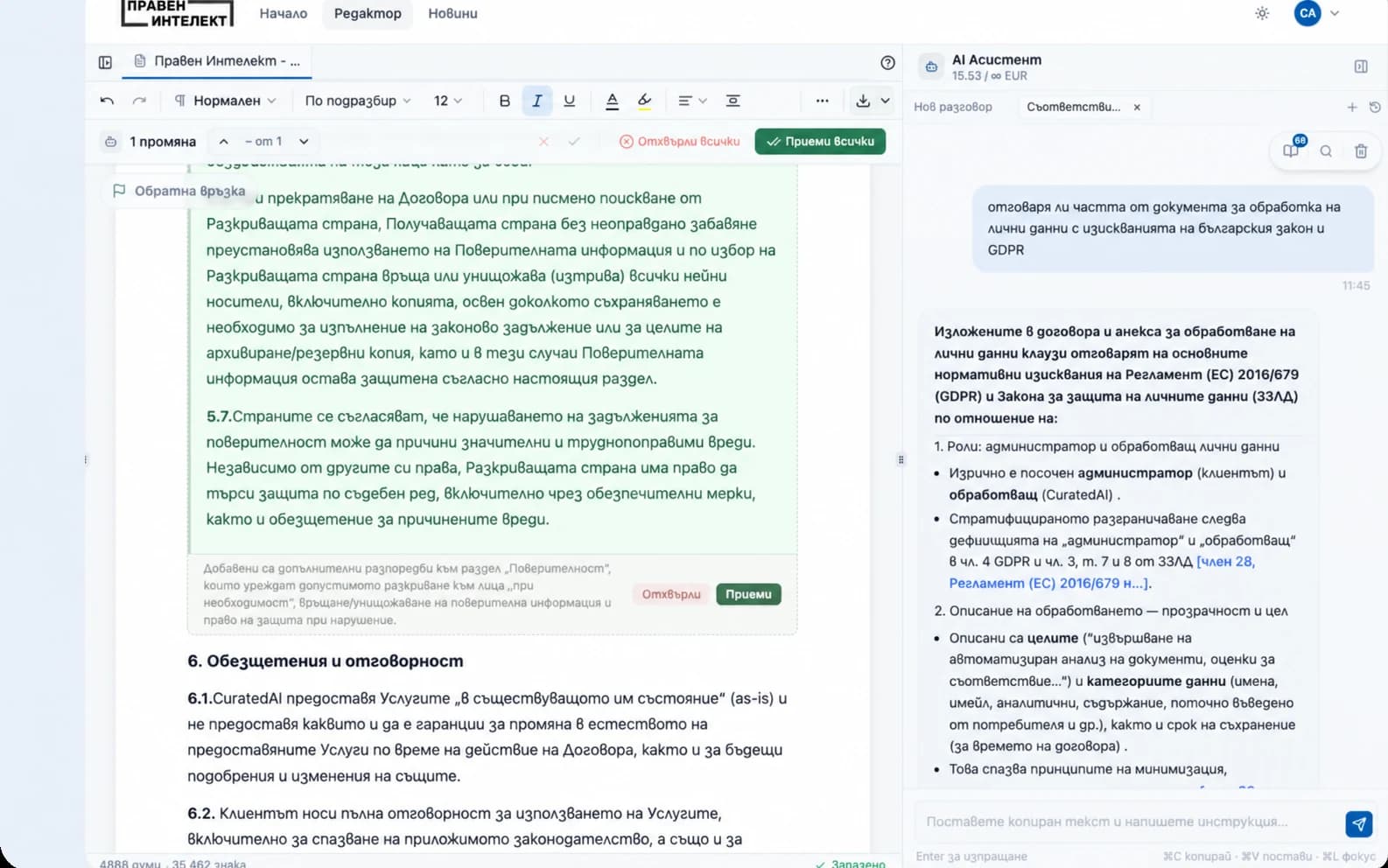
What Is Generative Artificial Intelligence and How Does It Work?
What Is Generative Artificial Intelligence
Generative artificial intelligence (AI) is a class of AI systems that create new content: text, code, images, audio, and video.
Rather than merely classifying or organizing information, these systems generate a continuation, a summary, a translation, a counterargument, or an entirely new structure based on the patterns they have learned from data.
How It Actually Works: Predicting the Next Token
At the heart of generative AI lies a simple idea: the model always predicts the next small unit of text, called a token. A token can be a whole word ("contract"), part of a word ("compen-" + "sation"), or even just a punctuation mark. By combining these elements one after another, the model builds entire sentences, paragraphs, and documents.
The process by which a generative AI model works is as follows:
-
The text entered by the user (including the prompt) is first broken down into tokens.
-
The model examines the sequence it has been given so far and calculates a probability for each possible next token.
-
A token is selected according to a particular strategy - it might be the most probable one, or a more varied choice produced by techniques such as "temperature" or "nucleus sampling."
-
The new token is added to the text, and the process repeats until a sentence, a paragraph, or an entire document is produced.
In practice, this simple mechanism leads to remarkably flexible behavior. The model does not know the full text in advance; it writes it out word by word, guided by statistical dependencies. This allows it to create new combinations, adapt its style to the task at hand, and respond dynamically to the user's prompt.
Two key consequences follow:
-
Prompts carry enormous weight. They set the starting sequence and steer the probability distribution. If we clearly specify context, role, goal, and format (for example, "Write a three-point summary of a court ruling"), the model produces more accurate and useful results.
-
The context window is the limit of the model's memory. The model sees only part of the conversation. If the text is longer, the earliest parts drop out of the context window and are not retained in the chat's memory. That is why it is good practice to supply important information explicitly, or to use techniques for retrieving the most relevant excerpts from a larger document (which is exactly what we do at Praven Intelekt).
In other words, generative AI does not think like a human; it constantly calculates the next most probable step. But when combined with well-formulated prompts and sound context management, this simple principle yields an exceptionally powerful tool for creating and analyzing text.
A Brief History: How We Got Here
The 1960s: Rules and the Illusion of Understanding
The chatbot ELIZA, built by Joseph Weizenbaum, was the first emblem of conversational artificial intelligence, introduced to the world back in the 1960s. ELIZA worked by matching word patterns and rephrasing sentences. Its most popular script, DOCTOR, imitated a conversation with a therapist by turning a question back to the speaker or emphasizing key words. The system had no linguistic understanding - only a clever use of templates and pre-set sentences that created a feeling of empathy.
Weizenbaum also revealed a risk that remains characteristic of generative AI today: people are inclined to attribute meaning and intent to systems that do not actually understand the world.
The 1970s to the 1990s: Expert Rules and Limited Worlds
After ELIZA came PARRY, which simulated a patient with paranoid disorder. It used more rules and internal states to appear consistent. Around the same time, the system SHRDLU demonstrated impressive dialogues in a narrow domain - the so-called "blocks world," where the system could "reason" about objects and actions, but only within a strictly limited universe. In the 1990s, ALICE and AIML made building chatbots more accessible through templates, categories, and simple content substitution.
The common problem persisted: all of these systems required manually enumerating the rules they were to follow, and they quickly broke down outside their prepared scenarios. This is also why they had little practical use beyond academic settings.
The 2000s: The Statistical Era
At the start of the new millennium, artificial intelligence began to rely not only on rules but also on statistics. Researchers used enormous collections of texts and examined which words most often appeared together. In this way, models began to guess the next word based on probabilities.
This made translations and texts smoother than those of the first chatbots, yet they still lacked genuine memory and understanding. Conversations sounded disjointed, and in complex fields such as law, the results often required a great deal of human correction.
The 2010s: Neural Networks
This decade brought a major breakthrough through the development of neural networks. The new models could now "read" longer texts and retain context, making them much closer to the way humans think. Words were represented through numerical relationships, so that similar terms were recognized as related in meaning. An attention mechanism also emerged, allowing the model to weigh which parts of a sentence were most important.
In 2017, the Transformer architecture (the T in GPT) made it possible to process huge volumes of text faster and more efficiently. From then on, models were no longer trained only for a specific task; they were first trained on enormous amounts of text and then fine-tuned for more specialized purposes, including legal applications such as document analysis or fact extraction.
2018-2023: Large Language Models and the Dawn of the "Chatbot Era"
The next step was large language models, trained on enormous datasets - internet texts, books, articles, even code. These models no longer simply arranged words; they absorbed style, tone, and facts. A key improvement was instruction tuning and feedback from humans, which made these systems more useful and predictable in real conversation.
In parallel, image models also developed, and some systems began to combine text and pictures. By the end of this period, models became "multimodal," capable of using external tools such as a search engine or a calculator and of processing increasingly long documents.
This is the moment when artificial intelligence moved from the lab into everyday practice, and solutions like Praven Intelekt began using these technologies to support work with documents and analysis in Bulgarian law.
2024 and Beyond: Multimodality, Tools, and Agents
The current wave is moving toward even longer context, better factual reliability, and integration with external tools. Approaches are spreading such as retrieving knowledge from trustworthy sources before generating output, which reduces errors and enables citation (RAG, or retrieval augmented generation).
AI agents are emerging that plan steps, search, verify, and produce a result rather than just text. In practice, this makes robust workflows possible for legal teams, in which generative AI prepares drafts, compares versions, and extracts relevant passages, while the lawyer makes the final decision (this is the next step for Praven Intelekt as well).
Want to see how generative artificial intelligence can work for Bulgarian law?