What Is Retrieval-Augmented Generation (RAG)?
One of the biggest criticisms of generative models (such as GPT) is that they can sometimes hallucinate information or fall out of date. One of the most widespread and effective solutions to this problem is called Retrieval-Augmented Generation, or RAG.
This technology combines the power of large language models (LLMs) with access to up-to-date, reliable sources of information. That makes it especially valuable in professional settings, where accuracy and sound reasoning are often paramount.
What is RAG?
RAG is an architecture that optimizes the performance of an AI model by connecting it to databases external to the model - for example, an organization's internal data, academic papers, or specialized resources. In other words, it is a technique for improving the accuracy and reliability of generative AI models using information from specialized sources.
The term "retrieval-augmented generation" itself comes from a research paper published in 2020 by researchers from Meta AI and University College London. The idea behind the technology is to let an AI model work much like a judge - when more information is needed on a given case, the judge sends a clerk to the library to find in-depth material and bring it back. RAG works by the same analogy, informing the AI through additional reliable sources.
How does it work?
The main steps in the RAG process include:
-
Indexing - data (text, documents, etc.) is vectorized and stored in a high-performance database (a vector store)
-
Retrieval - when a question is asked, the system searches for the most relevant sources using semantic search
-
Augmentation - the retrieved content is injected into the prompt sent to the LLM, so the model can use it as the basis for its answer
-
Generation - the LLM produces an answer by combining its own parameters with the supplied sources

What are the main benefits of RAG?
-
Greater accuracy and reliability - the answer rests on verifiable sources, not just on knowledge baked into the model.
-
Up-to-dateness - information can be updated in real time, with no need to retrain the model.
-
Transparency and trust - the model can provide references or citations to the sources, making it easier to verify the answer.
-
Reduced training cost and effort - there is no need for constant fine-tuning; it is enough to update the knowledge bases.
-
Flexible integration - it can be used across many applications, from medical to legal assistants.
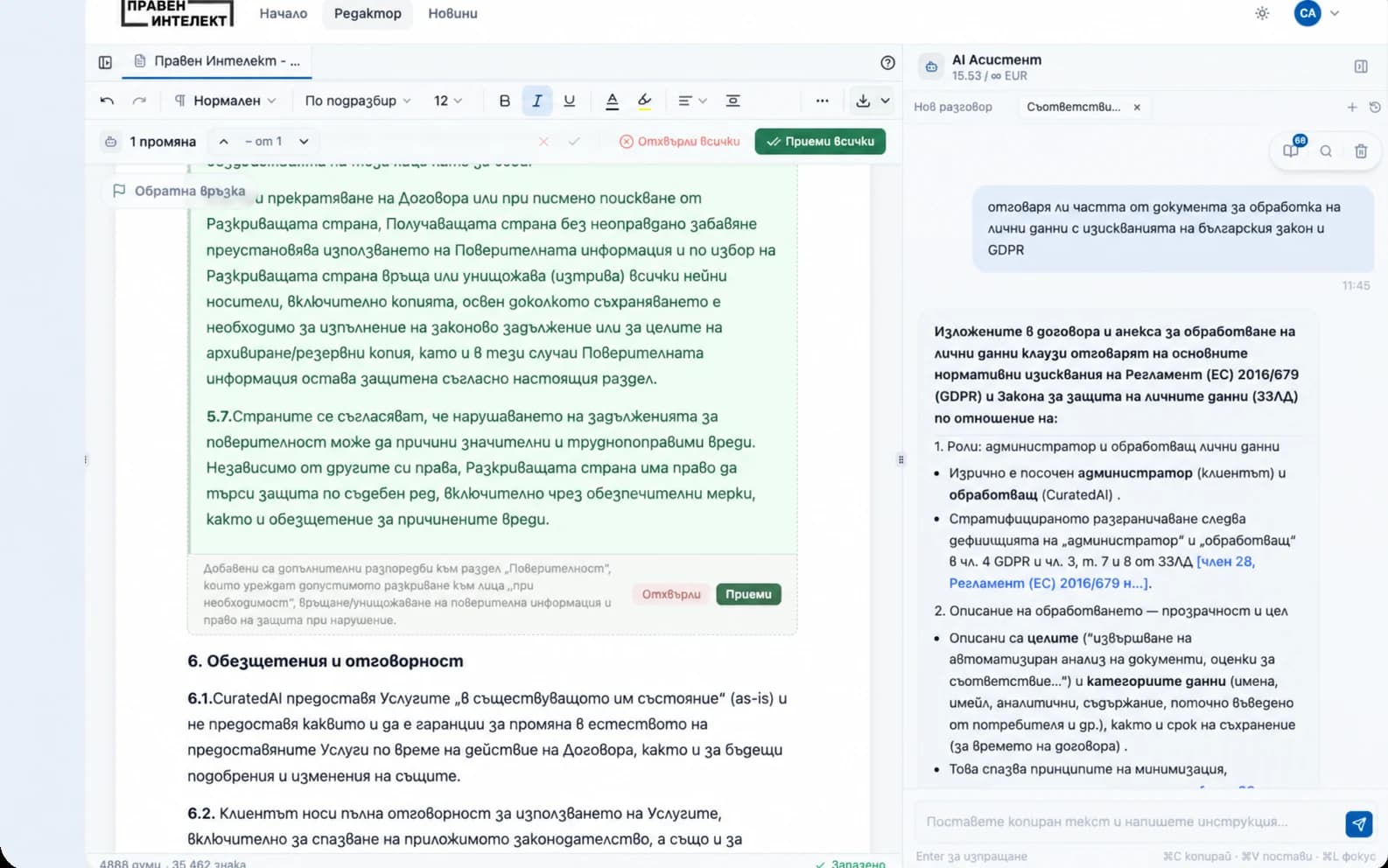
RAG is already taking shape as the gold standard for enterprise AI solutions built on internal data and for specialized tools such as Praven Intelekt, because it overcomes the main limitation of classic LLMs - their dependence on pre-trained parameters that do not always reflect current, organization-specific information.
Whereas an LLM can generate a convincing but inaccurate answer (a so-called "hallucination"), RAG first retrieves relevant documents from a reliable source database - for example, statutes, contracts, archives, and case law in the case of Praven Intelekt - and only then uses the language model to formulate the answer.
This ensures transparency, verifiability, and alignment with real data, which is decisive in the legal sector. For Praven Intelekt, it means that every answer is backed by a citation or excerpt from the law or case law, rather than by the model's guesswork.
LLM vs. RAG
Feature
Classic LLM
LLM + RAG (Retrieval-Augmented Generation)
Knowledge sources
Limited to the data it was trained on and what it can access online (fixed as of training time)
Dynamically retrieves information from up-to-date, reliable internal or external databases
Up-to-dateness
Has a cut-off date and does not include the latest information (e.g., no recent legislative changes)
The database can be updated daily, so the latest information is always included
Accuracy
Risk of "hallucinations" and false statements
Answers are based on a database of specially curated documents
Transparency
Sources of the answer are hard to trace
Can provide sources, references, and citations
Flexibility
Hard to adapt to an organization's specific data without additional training
Easily integrated with internal corporate or new legal databases
Maintenance cost
Requires regular fine-tuning to stay current
Updated by refreshing the database, with no new training
Level of trust
Limited, because answers are not always correct or verifiable
High, because every result is grounded in a real source
General-purpose models and applications like ChatGPT can be extremely useful for general knowledge and creative tasks, but RAG is the standard for enterprise and legal applications, where accuracy, up-to-dateness, and transparency are critical. That is why Praven Intelekt builds on RAG approaches to guarantee reliable legal analysis and research for attorneys and lawyers.