What Is Prompt Engineering and How Do You Give AI Better Instructions?

What Is Prompting and Why Does It Matter?
Prompting (from the English prompt) is the way a user formulates a request to an artificial intelligence system. It can be a question, an instruction, or a combination of both.
AI models work with a structure called tokens - small units of text (words or parts of words) that the system analyzes in order to understand the meaning of a request. The better structured a prompt is, the clearer the context becomes for the model, and the more accurate and useful the final answer.
The reason prompting matters so much is that AI does not think like a human. It does not interpret your intent in a broad sense; instead, it looks for probabilistic connections between the tokens you have used.
Why Does Prompting Work at All?
AI models do not understand the world the way people do. Instead, they operate through complex probability calculations and language patterns extracted from vast amounts of text. That is why the way we phrase our questions is decisive.
Here is how the process works:
-
The text is broken down into tokens.
Every line you enter is split into small units - words, parts of words, or even individual characters. For example, the word "intelligence" might be split into the following tokens: in | tel | li | gence.
-
The model calculates probabilities.
For each token, the system computes the most likely next element, drawing on billions of statistical connections learned from previous texts. This calculation happens within a fraction of a second.
-
Context is decisive.
Two identical questions can receive different answers depending on the details provided. For example, if you write "What is a net?", the model might think of computer networks, fishing nets, or social networks. But if you add "in computer science," it will immediately steer toward the right context.

Prompting works precisely because it directs the model's attention in the right direction. Generative artificial intelligence operates by arranging probabilities according to the words you have chosen. The more precisely you phrase your request, the clearer the "path" becomes that the AI will follow to generate an answer.
For example, if you ask a general question like "What does the law say about contracts?", the system will try to guess what exactly you mean, often unsuccessfully. But if you specify "What are the grounds for terminating a contract under the Obligations and Contracts Act?", the AI now has more concrete information about the kind of answer it should give and is far more likely to produce accurate and useful information.
Core Principles for Better Prompting
Whether you use AI as an assistant in law, business, education, or other projects, the quality of the answer depends on how you ask your question. Effective prompting combines the following elements:
1. Role
Give the AI a clear role or point of view - this helps it structure the answer in a way that fits your needs.
Example: "Imagine you are a project manager and need to prepare a brief report for the team based on the following document…"
2. Task
State a specific task using a verb: "summarize," "write," "structure," "draft a plan"…
Example: "Summarize this text in 5 sentences."
3. Context
Explain the specific context or setting - this helps the AI understand your goal and produce a more relevant answer.
Example: "I am a human resources specialist. Create a personalized training plan for a new employee starting in the sales department."
4. Format
Specify how you want the answer to look - as a list, a table, a paragraph, or a sample document.
Example: "Present this information in a table with two columns: steps and deadlines."
5. Clarity and Specificity
Use complete sentences and avoid vague or overly general wording. The more detailed your question, the more useful the answer will be. Research shows that prompts of around 20-25 words that include context and a specific goal work best.
6. Gradual Refinement
Prompting is a process. If the first answer is not accurate, ask follow-up questions. Every subsequent prompt is an opportunity to build on the result.
Example: "Add examples.", "Make it shorter.", "Explain it in plainer language."

The Difference Between a Strong and a Weak Prompt
Weak prompting
Strong prompting
"Make a summary."
"As a project manager, summarize this report in 5 key points so I can present it to the team."
"What does the company do?"
"Prepare a short presentation of our company [description, link to website] for an internal newsletter: 1 paragraph, friendly tone."
"Give me blog ideas."
"Suggest 5 blog post topics for a law firm working in family and inheritance law, each with a short summary and target audience."
How Praven Intelekt Makes Prompting Easier
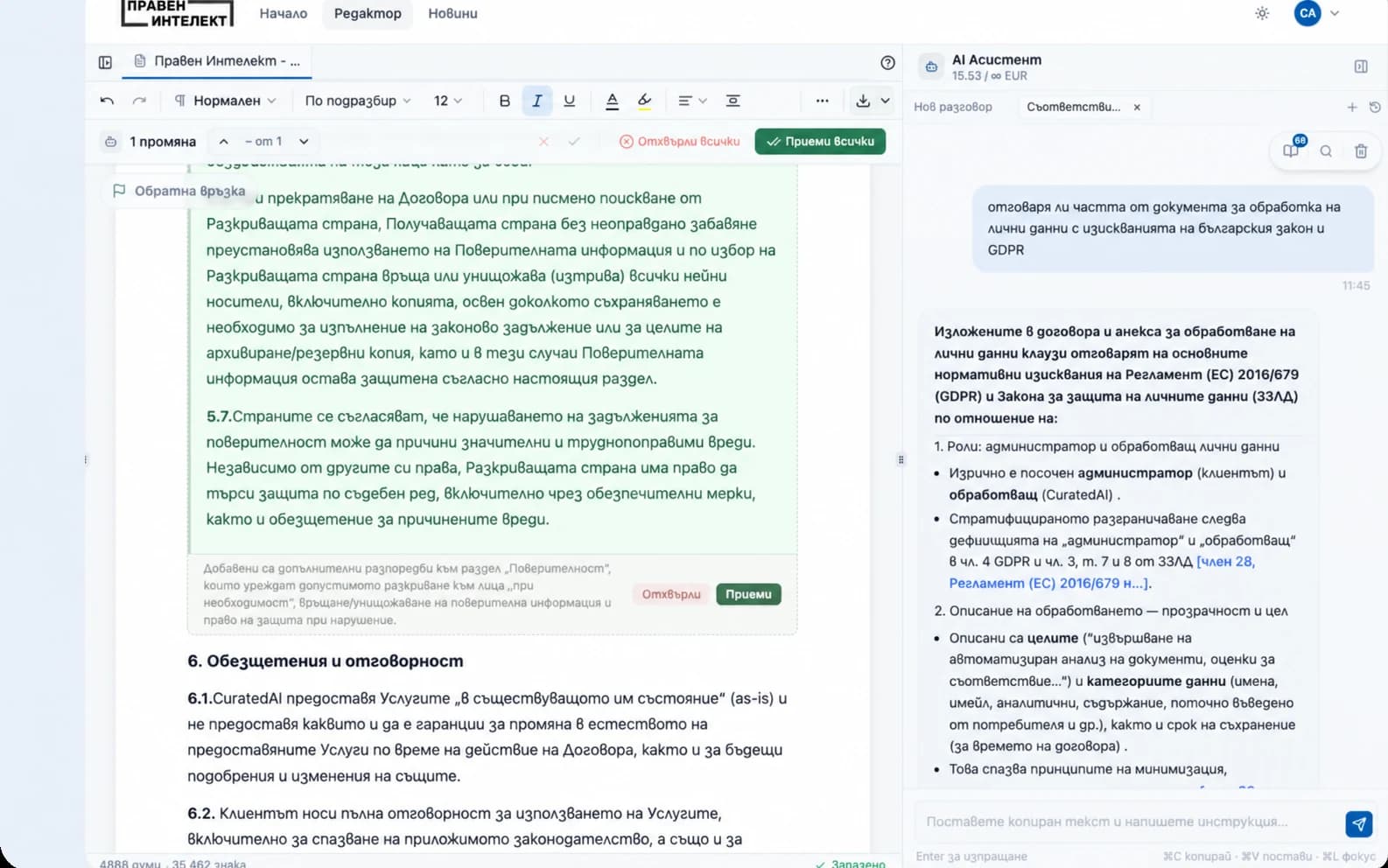
Understandably, most lawyers and legal professionals do not want to become experts in prompt engineering. That is exactly why Praven Intelekt uses a sophisticated system of pre-built prompts that guide the AI model to the right sources and structure the analysis in the best possible way.
This means users do not have to worry about the technical side of things. The only thing that matters is asking as clear and specific a question as possible, so the system can select the right legal sources - statutes, secondary legislation, and case law.
For example, if you ask "What are a tenant's rights when a lease is terminated early?", Praven Intelekt will automatically check relevant provisions of the Obligations and Contracts Act, search for case law, and offer you a reasoned, practical reference.