Praven Intelekt Passed the Bar Qualification Exam Without a Single Mistake
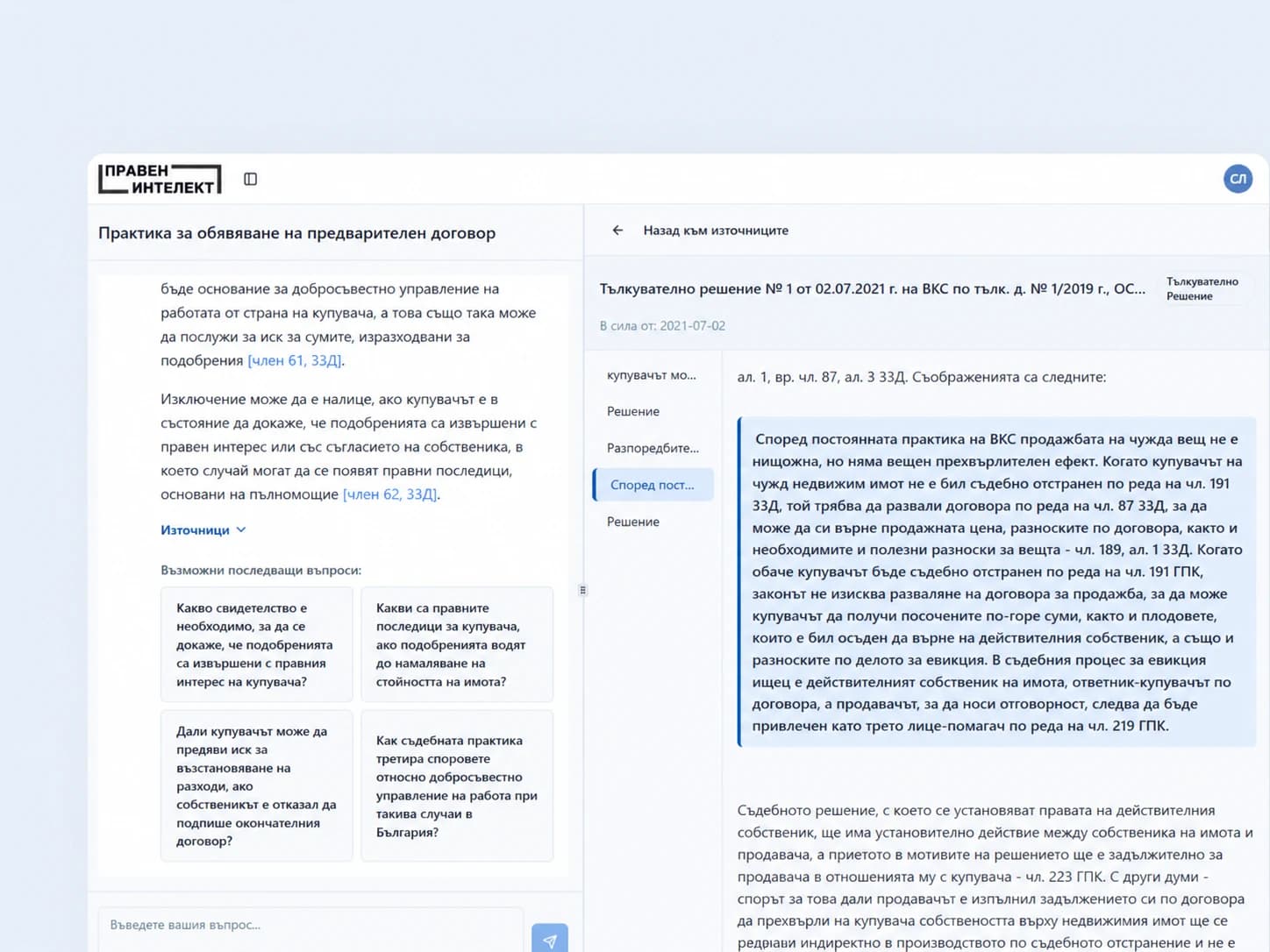
We are delighted to share that our AI assistant for Bulgarian law, Praven Intelekt, solved the legal qualification exam of 13 April 2025 without a single mistake!
Our goal was to test how the application answers questions based on Bulgarian legislation - not just with a), b), c), but together with the corresponding explanation and citations. That is why we prepared the table below, where you can see the exam questions and Praven Intelekt's answers to each of them, along with their reasoning.
The legal qualification exam is published on the website of the Ministry of Justice together with the official answers here.
How Praven Intelekt works
Praven Intelekt combines intelligent search technology with up-to-date legal data to provide accurate and verifiable answers to legal questions. It works in three main steps:
-
Intelligent search (RAG): When you ask a question, the system first searches for the most relevant legal sources - laws, secondary legislation, and so on. It then generates an answer based on those specific texts.
-
Working with up-to-date databases: Every day, the latest version of Bulgarian legislation is loaded (and soon national case law and EU law as well). This means that the answers always rest on the law currently in force.
-
Transparency and verifiability - Every answer contains references to specific articles and provisions. In the application, these are active links - you can immediately check exactly what the law says.
What is the difference from ChatGPT?
While ChatGPT answers based on a general pre-trained knowledge base (trained up to a certain date and largely based on American sources), Praven Intelekt:
-
Works and answers solely on the basis of Bulgarian law - not on global or generalized information.
-
Cites specific articles and laws with every answer and allows you to easily check the original text of the source.
-
Searches in real time across the current Bulgarian legal texts;
-
Does not "guess" and does not invent sources (we are sure you have asked ChatGPT to justify itself or cite its source and seen the disappointing result).
Exam questions and answers
In the table you can see Praven Intelekt's answers to each of the questions, with a corresponding brief justification and citation to the source. To better test how the product works, we asked the questions (wherever possible) without providing the answer options from the exam.
Note: Praven Intelekt's answers are copied directly, which is why you will see citations that look like this: [Art. 15 ZZD]. In the application, these citations are interactive links that lead directly to the corresponding legal provision, so that you can easily and reliably verify the answer yourself.
Question and answer
Praven Intelekt
1. Is the president of the Supreme Court of Cassation entitled to a second term?
Correct answer: c) no
Under Art. 129, para. 2 of the Constitution of the Republic of Bulgaria, it is clearly established that the president of the Supreme Court of Cassation is appointed for a term of seven years with no right of re-election [Article 129 KRB].
2. By whom are the inspectors of the Inspectorate at the Supreme Judicial Council elected?
Correct answer: b) the National Assembly
According to Art. 132a, para. 3 of the Constitution, the inspectors of the Inspectorate at the Supreme Judicial Council are elected by the National Assembly by a two-thirds majority of the members of parliament. [Article 132a KRB]
3. How many instances do the court proceedings under the Administrative Procedure Code /APK/ have?
Correct answer: a) two instances
Under the Administrative Procedure Code, court proceedings are two-instance, unless otherwise established by law [Article 131]. This means that administrative cases are first heard by an administrative court and may then be appealed before the Supreme Administrative Court, which is the second instance by way of cassation [Article 132 APK][Article 217 APK].
Which of the three options is correct: Coercive administrative measures may be applied: a) at the discretion of the administrative authority; b) to stop the commission of administrative offenses; c) to prevent and stop administrative offenses, as well as to prevent and remedy their harmful consequences.
Correct answer: c)
Correct option: c)
Explanation: Under Art. 22 of the Administrative Offenses and Penalties Act, coercive administrative measures may be applied "to prevent and stop administrative offenses, as well as to prevent and remedy their harmful consequences" [Article 22 ZANN].
5. The administrative-penal proceedings that have been instituted are terminated if a penal decree has not been issued within what period from the drawing up of the act?
Correct answer: a) a period of six months from the drawing up of the act;
Under Art. 34, para. 3 of the Administrative Offenses and Penalties Act, it is provided that if a penal decree is not issued within 6 months of the drawing up of the act, the administrative-penal proceedings are terminated [Article 34 ZANN].
6. Which of the following is correct: A declaratory action regarding facts: a) is not admissible; b) is always admissible; c) is admissible in the cases expressly provided for by law
Correct answer: c)
A declaratory action regarding facts is admissible only in the cases expressly provided for by law. Under Art. 124, para. 4 of the Code of Civil Procedure (GPK), an action may be brought to establish the authenticity or inauthenticity of a document. An action to establish the existence or non-existence of other legally relevant facts is allowed only in the cases provided for by law [Article 124, GPK].
7. Which of the following is correct: Where the court has allowed a material breach of the procedural rules, the judgment rendered is: a) inadmissible; b) incorrect; c) null and void.
Correct answer: b)
A material breach of the procedural rules may give rise to a judgment that is to be classified as incorrect [Article 281, GPK]. The provision of Art. 281, point 3 of the Code of Civil Procedure states that a judgment may be classified as incorrect due to a material breach of the procedural rules [Article 281, GPK].
8. How are enforcement proceedings instituted?
Correct answer: c) before the enforcement officer by filing an application, with an attached writ of execution or another act subject to enforcement.
Enforcement proceedings are instituted upon the application of the interested party, who must state the case number and the writ of execution (or another act subject to enforcement). The body competent to conduct enforcement proceedings is the state or private enforcement officer. A precondition for commencement is the existence of a writ of execution issued by the relevant court [Article 426 GPK][Article 406 GPK].
**9. The tenant of real property is: **a) a possessor in good faith; b) a possessor in bad faith; c) a holder.
Correct answer: c)
The tenant of real property is a holder, not a possessor, whether in good faith or bad faith.
Under Art. 70 of the Property Act, a possessor is only a person who exercises factual control over the thing and has the intention to hold it as their own [Article 70 ZS]. The tenant has no such intention, since they use the thing on the basis of a lease agreement without any claim to ownership.
10. The right to seek a declaration that a contract is null and void: a) is extinguished within three years of its conclusion; b) is not extinguished; c) is extinguished within one year of its conclusion
Correct answer: b)
Correct answer: b) the right is not extinguished.
Under Art. 26 of the Obligations and Contracts Act, contracts that are null and void produce no legal effect, and their nullity may be invoked without any limitation in time [Article 26 ZZD]. By contrast, voidability is subject to time limits for exercise, set out in Art. 32 (three years) and Art. 33 (one year).
**11. Under what limitation period are claims for compensation and penalties arising from a non-performed contract extinguished?
**Correct answer: b) a 3-year limitation period;
Under Art. 111 of the Obligations and Contracts Act, "claims for compensation and penalties arising from a non-performed contract are extinguished upon the expiry of a three-year limitation period" [Article 111, ZZD]. This provision applies to both civil and commercial contracts, unless commercial legislation provides for a different period.
12. Where performance is insufficient to cover the interest, the costs, and the principal, in what order are they discharged?
Correct answer: c) costs, interest, principal
Where performance is insufficient to cover all obligations, the order of discharge is: first the costs, then the interest, and finally the principal under Art. 76 of the Obligations and Contracts Act.
13. In what form must the preliminary contract under Art. 19 of the ZZD for the sale of real property be concluded in order to be valid?
Correct answer: a) written form
For a preliminary contract for the sale of real property to be valid, it must be concluded in written form and must contain agreements on the essential terms of the final contract, under Art. 19 of the Obligations and Contracts Act (ZZD).
14. The action under Art. 135 ZZD, brought by a creditor seeking a declaration that a contract for the sale of a thing concluded between the debtor and a third party is relatively ineffective against them, is:
a) an action for performance;
b) a constitutive action;
c) a declaratory action
Correct answer: b)
The legal character of the action under Art. 135 ZZD is constitutive. It seeks a declaration of relative ineffectiveness of a legal transaction against the creditor, which alters the legal reality for the parties. For this reason it has a constitutive character - it creates a new legal situation between the creditor and the third party [Article 135 ZZD].
15. There is NO discharging effect with respect to a monetary obligation in the case of: a) payment of the obligation; b) set-off between the obligation and a counterclaim of the debtor against the creditor; c) acknowledgment of the obligation made by the debtor.
Correct answer: c)
Option c) acknowledgment of the obligation.
Under Bulgarian law, payment produces a discharging effect on obligations if it is made in the prescribed manner [Article 75 ZZD]. Set-off, as a statutorily regulated method, also discharges obligations, up to the amount of the mutual due claims [Article 90 ZZD].
On the other hand, an acknowledgment of the obligation by the debtor only confirms its existence, but does not lead to its performance or discharge.
16. Joint and several liability between debtors arises:
a) if agreed in a concluded contract or provided for by law;
b) only if agreed in a concluded contract;
c) only if provided for by law.
Correct answer: a)
Correct answer: a). Article 121 of the ZZD provides that joint and several liability between debtors arises only when expressly agreed, except in the cases determined by law [Article 121 ZZD]. The law establishes joint and several liability in specific cases, for example:
upon the entry of a third party as a co-debtor with the creditor's approval (Art. 101 ZZD); for guarantors, who are jointly and severally liable with the principal debtor (Art. 141 ZZD).
17. A person who may NOT be a sole trader is one who:
a) carries out agricultural activity
b) is an undischarged insolvent;
c) practices a liberal profession.
Correct answer: b)
Persons who are undischarged insolvents may not be registered or operate as sole traders [Article 57 TZ]. Persons who carry out agricultural activity or practice a liberal profession are not regarded as traders within the meaning of the law, unless their activity can be classified as an enterprise [Article 2 TZ].
18. Where a person acts in the name of a trader without authority to represent, the trader is deemed to confirm the actions if: a) they expressly agree to the transaction; b) they confirm the transaction after being notified by the ostensible representative; c) they do not object to the transaction immediately upon learning of it
Correct answer: c)
The correct answer is: c) they do not object to the transaction immediately upon learning of it.
Under Art. 301 of the Commercial Act: "Where a person acts in the name of a trader without authority to represent, the trader is deemed to confirm the actions if they do not object immediately upon learning of them" [Article 301 TZ]. This means that the absence of timely objection constitutes tacit consent to the actions of the person who acted without authority to represent.
19. An action to set aside a resolution of the company's general meeting under Art. 74 TZ: a) may be brought only with respect to resolutions subject to entry in the commercial register; b) may be brought only by a partner/shareholder who voted against the relevant resolution; c) may be brought by a partner/shareholder who has a legal interest.
Correct answer: c)
Correct answer: c) Under Art. 74 of the Commercial Act, any partner or shareholder may bring an action before the district court at the company's seat to set aside a resolution of the general meeting where it contradicts the mandatory provisions of the law or the articles of incorporation, or the company's bylaws, as the case may be [Article 74 TZ]. This does not require the partner/shareholder necessarily to have voted against the resolution or for it to be subject to entry in the commercial register. The main requirement is the existence of a legal interest, which includes affected rights based on the law, the articles of incorporation, or the bylaws.
20. A marriage contract may NOT contain a clause for: a) a testamentary disposition of real property; b) maintenance of the children of the marriage; c) transfer of property held in matrimonial community ownership into the sole ownership of one spouse.
Correct answer: a)
A testamentary disposition of real property may not be included in a marriage contract. Under Art. 38, para. 3 of the Family Code, a marriage contract may not contain dispositions in the event of death, which includes testamentary dispositions [Article 38 SK]. This is the main restriction on the content of a marriage contract in the context of wills.
21. A minor under the age of 14 is criminally liable: a) always; b) only if they were able to understand the nature and significance of the act and to control their conduct; c) is not criminally liable.
Correct answer: c)
Minors under the age of 14 are not criminally liable under Bulgarian law, regardless of their ability to understand the nature and significance of their actions. Under the Criminal Code, Art. 32, para. 1, minors under the age of 14 do not bear criminal liability [Article 32 NK]. In the event that a minor under 14 commits a socially dangerous act, educational measures may be applied, but not criminal liability [Article 32 NK].
22. Is preparation to commit an offense punishable?
Correct answer: b) only in the cases provided for by law;
Yes, preparation to commit an offense is punishable in Bulgaria, but only in the cases provided for by law. Under Art. 17, para. 2 of the Criminal Code, preparation is punishable only if the law expressly provides for it [Article 17 NK].
Preparation consists of acts such as preparing means, finding accomplices, and creating conditions for the commission of an offense, before its execution has begun [Article 17 NK].
The perpetrator is not punished if, on their own initiative, they abandon the commission of the offense [Article 17 NK].
23. The criminal result of fraud under Art. 209 of the Criminal Code is: a) the pecuniary benefit that the perpetrator obtains; b) the property damage caused to the victim; c) the offense is a formal one.
Correct answer: b)
The correct answer is: b). The criminal result of fraud under Art. 209 of the Criminal Code is the causing of property damage to the victim, which is a consequence of the deception that was induced or maintained, and not merely the obtaining of a pecuniary benefit for the perpetrator [Article 209 NK].
24. Where the perpetrator intended to kill two or more persons, but for reasons beyond their control only one of them died, criminal
liability will arise for:
a) murder of one person;
b) attempted murder of more than one person;
c) murder committed in a manner dangerous to the lives of many.
Correct answer: b)
The offense must be classified as attempted murder of more than one person under Art. 116, para. 1, point 4 of the NK (in conjunction with Art. 18 of the NK). Where the perpetrator has the intention (direct intent) to kill two or more persons, but for reasons beyond their control only one of them dies, not all of the intended criminal results have been achieved. Under Art. 18, para. 1 of the Criminal Code, any act directed at the commission of an offense is an attempt where the offense is not completed for reasons beyond the perpetrator's control. Since the perpetrator's intention was directed at causing the death of more than one person, but the result is partial, the case involves both a completed murder and an attempted murder. It is therefore classified as attempted murder of more than one person [Article 116 NK].
25. Release from criminal liability with the imposition of an administrative penalty is: a) a matter for the prosecutor's subjective assessment after the conclusion of the pre-trial proceedings; b) a matter for the court's subjective assessment after the conclusion of the court proceedings; c) it follows from mandatory statutory preconditions, in the presence of which the deciding body has no right to refuse to apply this differentiated procedure.
The answer is c). Release from criminal liability with the imposition of an administrative penalty is governed by Art. 78a of the Criminal Code. It is possible where there are mandatory statutory preconditions, with the court having no right to refuse to apply it, if all of these preconditions are present [Article 78a NK]. Under Art. 78a NK, release from criminal liability with the imposition of an administrative penalty applies where the following cumulative conditions are met:
-
The offense is punishable by imprisonment of up to three years (or five years in the case of negligence) or another lighter penalty.
-
The person has not been convicted of an offense of a general nature and has not been released under this article.
-
The property damage has been remedied [Article 78a NK].
26. The absolute limitation period, under the Criminal Code, occurs: a) when a period defined by law, differentiated according to the severity of the penalty provided for the specific offense, expires without criminal prosecution having begun against the perpetrator; b) when a period of not less than 30 years from the commission of the offense expires without criminal prosecution having begun against the perpetrator, regardless of the type and severity of the penalty provided for it; c) upon the death of the perpetrator
Correct answer: a)
Option a) is correct. The absolute limitation period for criminal prosecution is provided for in the Criminal Code, Art. 81, para. 3 [Article 81 NK]. According to the text: "Criminal prosecution is precluded if a period has expired that exceeds by one half the period provided for in the preceding article". This period is differentiated according to the severity of the penalty provided for the specific offense, as determined in Art. 80 [Article 80 NK]. The limitation period begins to run from the moment of the commission of the offense (Art. 80, para. 3), and if no steps for criminal prosecution have been taken, it precludes the possibility of commencing proceedings.
27. What is the maximum duration of the remand measure of "detention in custody" in pre-trial proceedings?
Correct answer: c) 1 year and 6 months
The maximum duration of the "detention in custody" measure in pre-trial proceedings depends on the severity of the offense. It is 1 year and 6 months if the accused has been charged with an offense punishable by more than 15 years' imprisonment or another more severe penalty [Article 63 NK].
28. The order by which the prosecutor rules on requests, comments, and objections made when the investigation is presented: a) is subject to appeal before a court; b) is subject to appeal before the higher prosecutor's office; c) is not subject to appeal.
Under Art. 229, para. 3 of the Code of Criminal Procedure, the order by which the prosecutor rules on requests, comments, and objections made when the investigation is presented is not subject to appeal [Article 229, NPK].
29. Is the prosecutor's order terminating the criminal proceedings subject to appeal before a court?
Correct answer: b) yes, it is subject to two-instance appeal;
Yes, the prosecutor's order terminating the criminal proceedings is subject to appeal before a court. Under Art. 243, para. 4 of the Code of Criminal Procedure (NPK), a copy of the order terminating the criminal proceedings is sent to the accused, to the victim or their heirs, or to the injured legal entity, who may appeal the order before the relevant first-instance court within 7 days of receiving the copy [Article 243 NPK]. The court hears the case in closed session and rules on the justification and lawfulness of the order [Article 243 NPK]. The court's ruling under Art. 243, para. 6 may be appealed or protested before the relevant appellate court, with the appellate court ruling by a final order [Article 243 NPK].
30. The participation of a prosecutor in court hearings in cases of a general nature is: a) mandatory; b) mandatory only in cases concerning serious offenses; c) at the prosecutor's discretion.
The participation of a prosecutor in court hearings in cases of a general nature is mandatory. This requirement is expressly provided for in Art. 268 and Art. 329, para. 1 of the Code of Criminal Procedure, which state that the participation of the prosecutor in the court hearing in cases of a general nature is mandatory [Article 268 NPK][Article 329 NPK].
We are looking for partners to test Praven Intelekt and give us feedback, so that we can make it as useful as possible to Bulgarian attorneys and lawyers. You can register directly here or contact us at [email protected].