The Top 5 Applications of Artificial Intelligence in Law Today
Artificial intelligence is now an everyday part of the work of lawyers and corporate legal departments around the world. Recent market research shows rapid and sustained adoption of both "classic" AI and generative AI (learn more about the difference in our article on the topic).
According to Clio, the share of legal professionals using AI in their day-to-day work jumped to 79% in 2024, and clients increasingly expect firms to deploy these technologies. According to a 2024 global survey by Wolters Kluwer (covering the US and 9 European countries), 76% of lawyers in corporate legal departments and 68% of lawyers in firms use generative AI at least once a week, while 58% of firms and 73% of corporate legal departments plan to increase their AI investments over the next three years.
Below are the five most common applications of AI in law today, ranked by actual usage among lawyers and legal professionals, according to a survey by Thomson Reuters Legal.
-
Document Review and Analysis
The most widespread use case. 74% of the lawyers surveyed cited document review and analysis as the leading application of generative AI in their daily practice. This is a broad category of activities in its own right, which can include:
-
in litigation: reviewing evidence and communications; analyzing arguments and counter-arguments in a statement of claim, response, or brief; assessing potential grounds for appealing a court decision, and more.
-
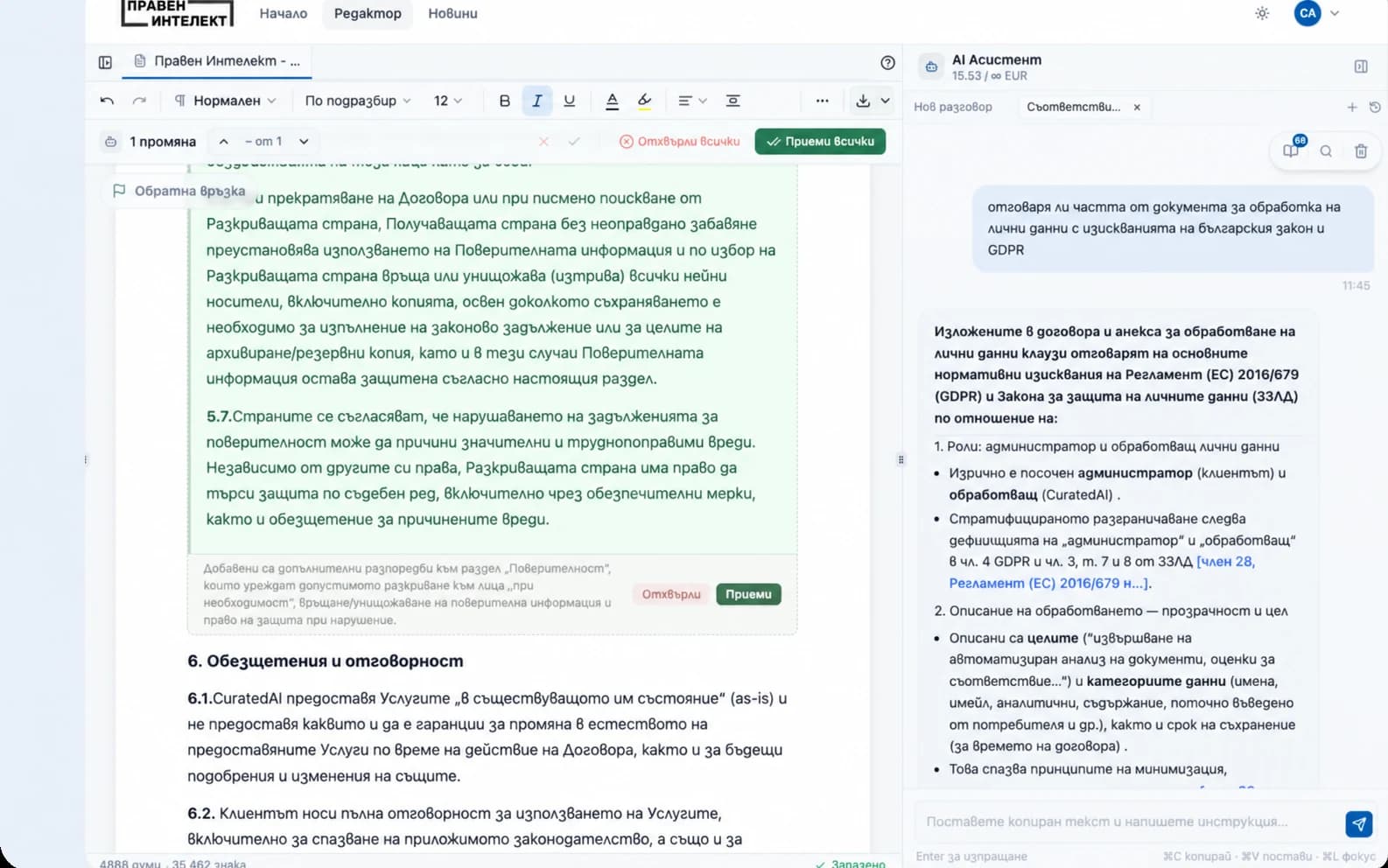
in contract review: comparing versions, detecting unfair clauses in consumer contracts, analyzing and identifying risks, and more.
This application of artificial intelligence is particularly significant because lawyers spend, on average, 40 to 60 percent of their time creating and revising documents.
Praven Intelekt offers these capabilities in its "Document Analysis" module, which we will continue to develop in order to cover as many of the day-to-day needs of lawyers and legal departments in Bulgaria as possible. You can read more about our "Document Analysis" module here.
-
Legal Research
According to the Thomson Reuters Legal survey, around 73% use AI for legal research. This is no surprise, since generative AI tools help to find and synthesize the most relevant rules and case law.
By asking a single question, AI can find the relevant legal sources by meaning, replacing keyword searches across hundreds of documents. In addition, its generative capabilities make it possible to produce direct answers to questions, summaries, comparisons, and more. This allows you to cut hours of searching down to minutes.
For this application of artificial intelligence in law, however, it is most important to use specialized legal tools. We are all familiar with notable cases in which lawyers were caught citing nonexistent cases because they relied blindly on ChatGPT.
Praven Intelekt prevents this possibility by working only with a database of official Bulgarian legislation and case law. You can read more about our "Legal Research" module here.
-
Summarizing Materials
Another widespread application of AI for lawyers is summarizing materials. Around 72% of lawyers in the US already use AI for document summarization. This capability is especially important in litigation, where you work with a large volume of documents and information. In high-volume cases, it becomes necessary to quickly and accurately get your bearings on facts, timelines, and the positions of the parties-something artificial intelligence can be particularly useful for.
-
Drafting Litigation Documents and Briefs
59% of the lawyers interviewed use generative AI to create briefs and drafts of litigation documents (brief/memo drafting). AI tools assemble a first version of statements of claim, responses, objections, briefs, and internal memoranda, following a defined structure and style that the lawyer then edits and validates.
-
Contract Drafting
51% of legal professionals already use AI for contract drafting and templates, including generating clauses, checking for gaps, and harmonizing terminology across versions and languages.
With the Praven Intelekt "Contract Drafting" module, you can use this AI capability to create contracts and clauses based on Bulgarian legislation. Through a series of specialized instructions, questions, and sources, we enable you to generate ready-made templates tailored to your case in minutes. You can read more about our "Contract Drafting" module here.
Praven Intelekt is a specialized AI legal assistant for Bulgarian law that lets you take advantage of the capabilities of generative artificial intelligence, adapted for Bulgarian practice.