Where AI Is Used Most Today: Applications for Business
Where is artificial intelligence used most today?
Globally, the most widespread enterprise applications are highly pragmatic and centered on automation and security. According to the IBM Global AI Adoption Index, the most frequently reported use cases are:
-
IT process automation - 33%,
-
threat detection and security - 26%,
-
AI monitoring and governance - 25%,
-
automating document processing and routing - 24%,
-
business analytics - 24%,
-
customer and employee self-service - 23%,
-
business process automation - 22%,
-
fraud detection - 22%,
-
marketing and sales - 22%,
-
knowledge search and discovery - 21%.
These figures are averaged across enterprises with more than 1,000 employees and show where AI is already standard practice rather than a pilot project.
By industry, financial services lead, with nearly half of IT professionals reporting actively deployed AI, followed by telecommunications and industrial manufacturing.
Where is generative AI used?
According to McKinsey, most organizations are deploying generative AI (generative AI or genAI) in marketing and sales, product and service development, customer service, and software engineering and IT. 71% of respondents say their firm already uses genAI in at least one function, and among those using it, 63% generate text, more than 1/3 generate images, and more than 1/4 generate code.
Customer service is one of the fastest-growing areas for generative AI. Gartner reports that 85% of service leaders plan to explore or pilot conversational customer solutions powered by genAI in 2025.
In parallel, a new generation of AI voice agents is entering call centers, and by 2028 a significant share of new centers is expected to rely on AI.
Summarized from data by McKinsey and IBM, the following are the most widespread applications of genAI:
-
Automation and IT operations, including systems monitoring, are the No. 1 applications.
-
Security, anomaly detection, and fraud detection are among the most common in heavily regulated industries (banks, insurance agencies, fintech companies).
-
Document workflows and knowledge management, from extraction and classification to intelligent search, are already standard use cases.
-
Marketing and sales, customer service, and product development are the areas where generative AI creates the most direct commercial impact.
Applications of AI in law
The legal sector is adopting AI rapidly, though the statistics vary depending on the methodology of each study. Clio reports that 79% of lawyers and legal counsel used AI in some form in 2024 (this figure, however, is for the United States). Thomson Reuters reports 26% active genAI users in 2025 and over 95% expecting that generative AI will become central to their workflows within 5 years. The numbers vary, but the direction is the same: rapidly growing adoption.
These are the 5 most common and widespread applications of AI in law today, according to a study by Thomson Reuters Legal:
-
Document review and analysis, including contracts: this is the most widespread way legal professionals use artificial intelligence. 77% of lawyers already use AI for document review. Among corporate legal departments, 64% specifically cite contracts as a leading use case (drafting, review, comparison, risk identification).
-
Legal research - 74% use AI for legal research and finding relevant case law and statutes. This is one of the most established ways to cut work from hours to minutes.
-
Summarizing materials - 74% apply AI to summarize court rulings, evidence, and correspondence, which speeds up case preparation and due diligence processes.
-
Drafting - 59% generate first versions of written materials such as opinions, memoranda, and procedural documents, which they then edit.
-
Translation and adaptation of legal texts - 38% of corporate legal teams use AI to translate and adapt documents across languages and jurisdictions.
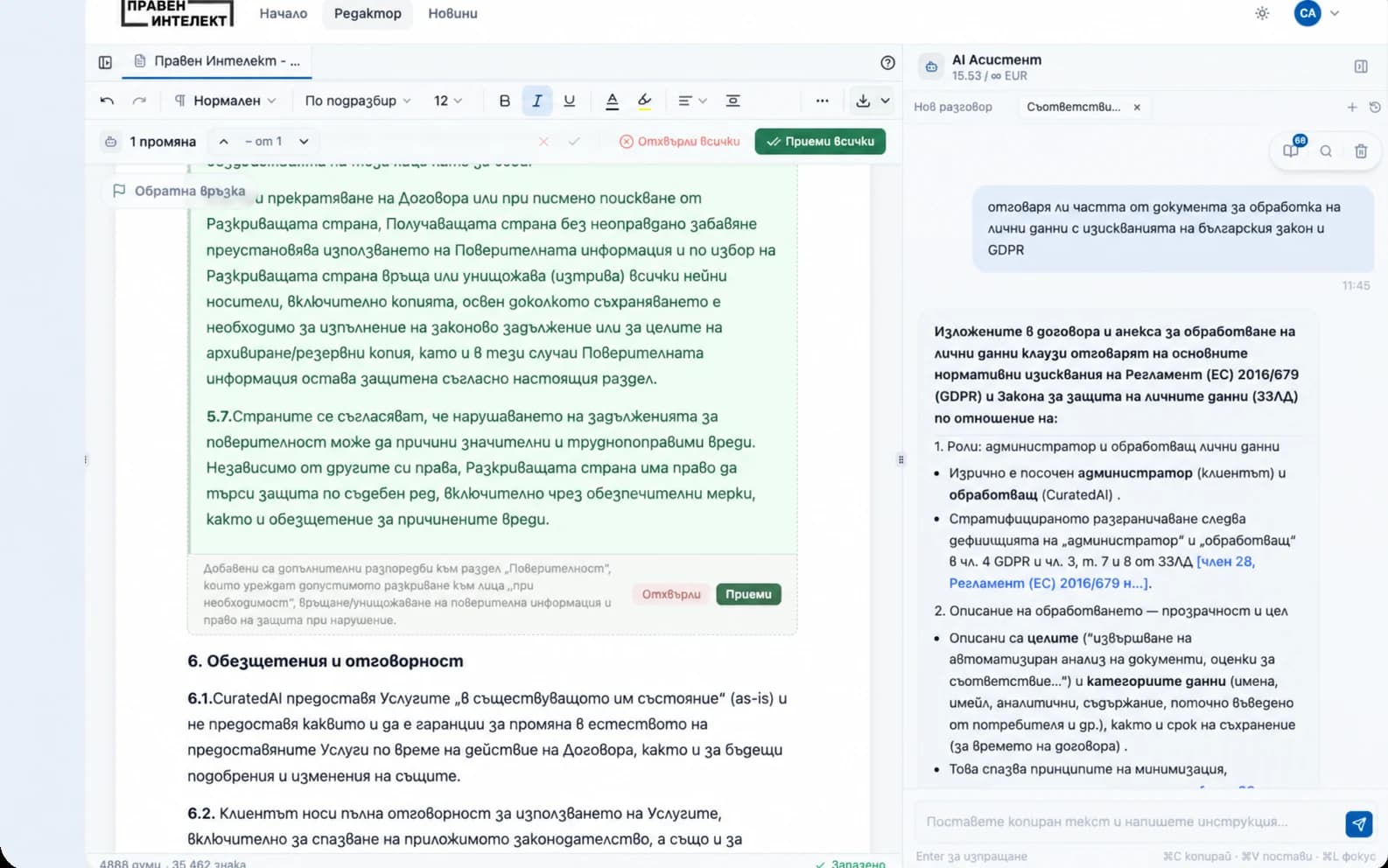
Praven Intelekt - the specialized AI for Bulgarian law covers the first four categories directly. With its modules for (1) Legal research, (2) Contract drafting, and (3) Document analysis, it works as your AI lawyer and assistant. The result is faster research and document analysis grounded in Bulgarian legislation and case law. You can learn how Praven Intelekt works here.
If you want your team to work faster, more consistently, and with lower risk, try Praven Intelekt today!