What Are AI Agents?

What are AI agents?
AI agents are software systems that can carry out tasks and achieve set goals on their own, on behalf of a user or another system. They can take on tasks, plan them, and execute them in place of a human.
Think of them as a virtual assistant that not only understands what you want, but also decides on its own how best to reach the result. Unlike ordinary chatbots, which hand you ready-made answers, AI agents can:
-
break a complex task down into small steps;
-
decide how to act in any given situation;
-
use a range of tools (for example, search for information online, generate text, or analyze data);
-
remember previous actions and adapt to changes.
Their intelligence comes primarily from large language models (LLMs), which understand and process human language. But agents go further - they aren't limited to conversation; they can launch external applications, automate processes, and even delegate subtasks to other agents.
How does an AI agent work, step by step?
-
**Setting a goal **The user (or the system's developer) provides a specific goal. This could be a simple task ("Find me the cheapest flights to Paris") or a more complex one ("Create a complete business plan for a new online store"). Along with the goal, the boundaries are set as well - which tools and data the agent is allowed to work with.
-
Planning and breaking the work into smaller tasks Once it knows what it needs to achieve, the agent starts to think strategically. It breaks the big goal down into smaller subtasks. For example, if it has to organize a trip, it will create separate steps: checking flights, searching for hotels, comparing prices, checking the weather. This way the task becomes clear and manageable.
-
Execution At this stage, the agent starts to act. It uses external tools and resources - it can search for information online, perform calculations, send emails, fill in documents, or communicate with other agents. Importantly, it doesn't wait for a human to tell it each step; it acts independently within the bounds of the set goal.
-
Memory and self-improvement While it works, the agent doesn't forget what it has done so far. It records information, learns from experience, and can correct itself if it finds a better way to reach the result. For example, if it finds a cheaper flight or sees that a hotel is sold out, it will change its plan. Over time, these agents become more accurate and more efficient.
-
Human oversight Although agents can act autonomously, in the early stages it's always good to have a human keeping watch. That way the user can give feedback, correct mistakes, and teach the agent to perform better. As the technology develops, the human's role becomes more of a supervisory one than an operational one.

Image: FalcorDB
Practical applications of AI agents
AI agents are no longer just a theoretical concept - they are already in active use across various industries, showing how autonomous systems can transform business processes, scientific research, and even people's everyday lives.
Industry and automation
In manufacturing and industry, AI agents can be applied, for example, to machine maintenance. Siemens already uses an AI agent that monitors the operation of machines and equipment and predicts possible failures before they occur. The result of deploying the system so far has been a roughly 25% reduction in unexpected downtime, which leads to significant savings and greater efficiency.
Financial technology
In the world of finance, AI agents are used for automated trading strategies. JPMorgan is developing a system known as LOXM, which executes high-frequency trades while adapting to market dynamics and volatility in real time. This is an example of how agents can make complex decisions at high speed and manage enormous volumes of data better than human traders.
Software engineering and code maintenance
In the technology sector, AI agents can already write, analyze, and optimize large volumes of code. They support teams in software development, automate routine tasks, and even contribute to open-source projects. One example of a company using AI agents in this area is Cursor.
An AI agent for Bulgarian law
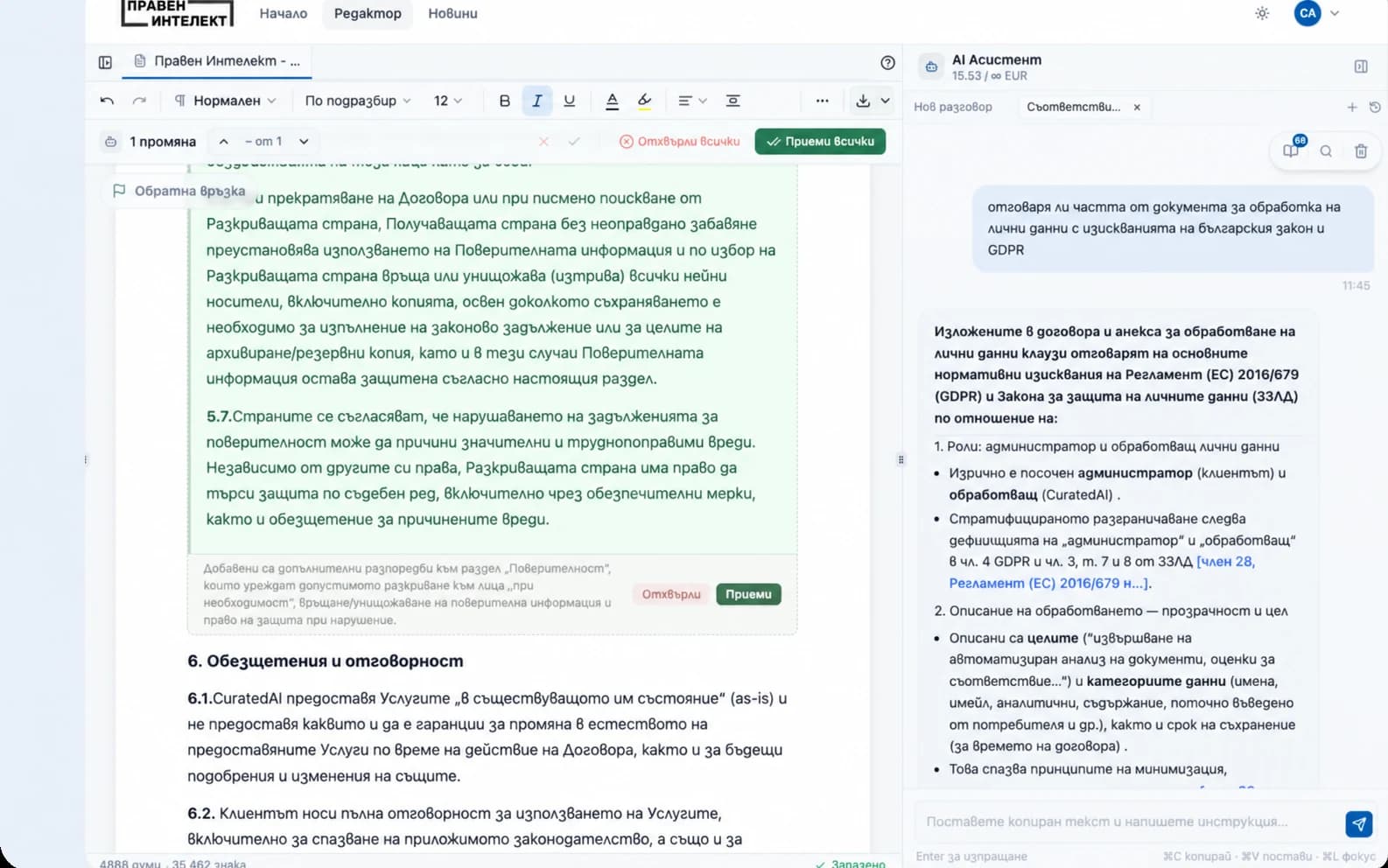
At "Praven Intelekt" we are already working on building a specialized AI agent for Bulgarian law. While the project is still in development, its goal is to act on its own - deciding whether to search for additional case law, find news online, analyze legislation, or summarize legal documents.
This way, instead of the user entering every step manually, the agent will be able to choose the most suitable path to the answer on its own, drawing on a combination of internal knowledge and external resources.